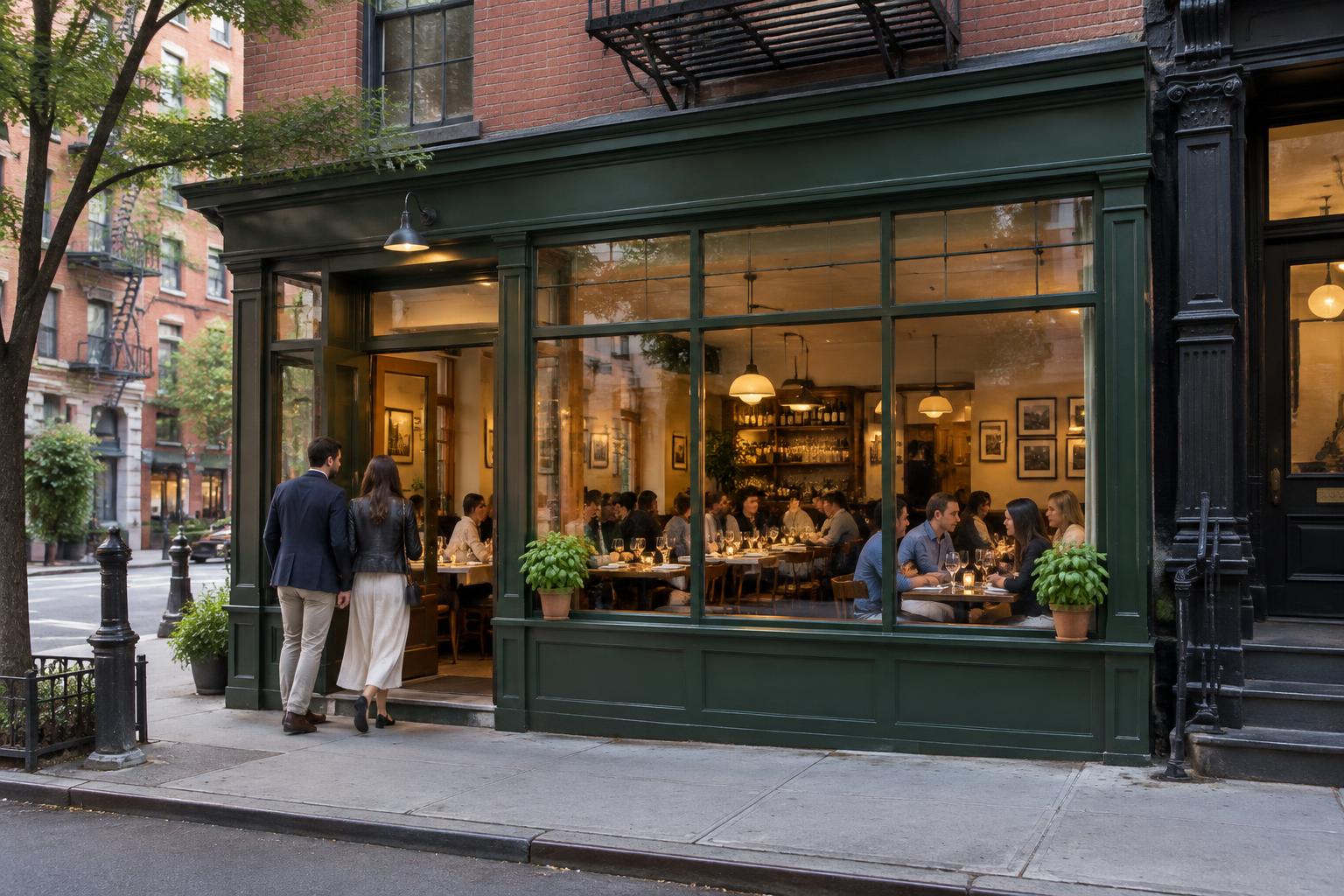
Turn neighborhood searches into a reason to choose your restaurant. Google Maps, honest reviews, and local search — built around your cuisine, your street, and your seats.
Not every search. The right guests.
A 34-seat neighborhood trattoria needs a different strategy from a destination tasting room. We focus on the dining occasions and local intent your restaurant can genuinely serve.
Google names relevance, distance, and prominence as local ranking factors. We improve what your restaurant can control; no agency can guarantee first place for every search. Google’s guidance ↗
Your restaurant is the brief
How we strategize
01
Read the room. Read the neighborhood.
We start with your cuisine, signature dishes, price point, service hours, and empty seatings. With your permission, we review your Google Business Profile, website search data, reservation records, and guest feedback. The goal is the right guests at the right time — not generic traffic.
02
Build a search-intent map
We compare the phrases guests actually use with nearby competitors and your real offering. A Ligurian trattoria might need to be discovered for ‘Italian restaurant West Village’ or ‘handmade pasta near Bleecker Street’; a sushi counter needs a different plan. We check demand rather than assume every phrase has search volume.
03
Make Google Maps match reality
We verify your restaurant name, address, pin, phone, categories, regular and holiday hours, menu, and reservation links. Fresh dish and dining-room photos show what guests will find. Descriptions reflect your cuisine and location without stuffing keywords into the business name.
04
Earn reviews. Never manufacture them.
We help your team invite genuine guests to share honest feedback through a review link or QR code. Everyone gets the same invitation — no screening for happy guests, rewards, bought reviews, or pressure for five stars. Replies are personal, and recurring feedback becomes an operational conversation.
05
Give each search a useful destination
We improve your restaurant’s mobile menu, booking journey, and accurate location information. Cuisine and neighborhood content answers real guest questions: what you serve, where you are, when you open, and how to reserve. Relevant local listings and editorial mentions reinforce consistency, not spam.
06
Measure, learn, adjust
We compare consistent reporting windows and separate discovery from reservations and seated covers. Search visibility, menu interactions, booking-link traffic, cancellations, and service capacity inform the next move. We review seasonality, promotions, and other channels before attributing a change to local SEO.
Illustrative strategy · Fictional restaurant and image · Not client work
Olive Bistro. Found in the Village.
Neighbourhood
West Village, Manhattan
Search area
The blocks between Bleecker Street, the Hudson River, Christopher Street, and Sixth Avenue
Signature dish
Trofie al Pesto, pounded each afternoon
Target seating
Wednesday, 6:30–8:00 p.m.
The brief
A 34-seat Ligurian-style Italian trattoria on a side street off Bleecker Street, in Manhattan’s West Village. Wednesday’s 6:30–8:00 p.m. tables need more diners who already live or work within a ten-minute walk of the front door — not a citywide audience that never arrives.
The tailored moves
Check discovery for handmade pasta and West Village Italian dining. Correct the entrance pin, show trofie and the intimate room, publish an accurate mobile menu, and put the Wednesday booking link one tap away. Invite every real guest to leave honest feedback.
The decision
If profile traffic rises but reservations do not, inspect menu clarity, availability, and the booking experience before chasing more views. If reservations rise but covers do not, review no-shows and cancellations with the host team.
Illustrative data · Not live analytics or a forecast
From discovery to dinner.
An example of the weekly report we would discuss with Olive Bistro — the same 34-seat trattoria off Bleecker Street in the West Village. Two equal 28-day windows, before and after the proposed changes, broken into single weeks. All numbers below are invented to explain the measurement approach — not actual results or a guarantee.
Baseline · 28 daysComparison · 28 days
Business Profile views
+50%
Measurement source: Google Business Profile
1,800
2,700
Website clicks from profile
+50%
Measurement source: Google Business Profile
120
180
Completed attributed reservations
+67%
Measurement source: Booking records + tagged links
18
30
Seated covers from those bookings
+67%
Measurement source: Host / reservation records
36
60
Bars compare each metric with itself, not with other metrics. Percentage changes are rounded. Profile views and clicks are not a unique-person funnel. Attributed reservations require booking records and source tracking; seated covers require attendance records. Untagged bookings and walk-ins may remain unattributed.
Sample weekly results
The same two windows, broken into single weeks. Each row is one Monday–Sunday period, pulled the following Monday. Weeks 1–4 are the baseline; weeks 5–8 are the period after the changes went live.
Illustrative weekly results for the fictional Olive Bistro example: business profile views, website clicks from the profile, attributed reservations, and seated covers, for weeks one to eight.
Week
Profile views
Website clicks
Reservations
Covers
Baseline · weeks 1–4 · 28 days
Week 14–10 May
420
26
4
8
Week 211–17 May
435
28
4
8
Week 318–24 May
450
30
5
10
Week 425–31 May
495
36
5
10
Comparison · weeks 5–8 · 28 days
Week 51–7 June
600
38
6
12
Week 68–14 June
645
42
7
14
Week 715–21 June
690
46
8
16
Week 822–28 June
765
54
9
18
Baseline total · 28 days
1,800
120
18
36
Comparison total · 28 days
2,700
180
30
60
Swipe the table sideways to see every column →
Illustrative figures invented for this example — not a client result, a forecast, or a guarantee. The week totals are the same 28-day numbers shown in the bars above.
Reservations means bookings attributed to the tagged profile link. Covers means seated guests from those bookings. Both are defined with their sources below.
Where each number comes from
One named source per column, pulled on the same day every week. If a figure has no reliable source, it does not go in the report.
Business Profile views
Source: Google Business Profile performance report for the restaurant’s verified listing
Exported every Monday for the previous Monday–Sunday window.
Website clicks from profile
Source: The same Business Profile export, using its website-click count
Exported the same Monday, over the same seven days.
Attributed reservations
Source: Reservation platform export, filtered to bookings made through the tagged profile link
Pulled every Monday and matched to the same window.
Seated covers
Source: Host stand or point-of-sale attendance records for those reservation numbers
Counted every Monday from the host book, same window.
The example adds 24 seated covers. Not 24 proven SEO conversions.
The comparison is 60 minus 36 covers. We would still investigate weather, holidays, other campaigns, available tables, and tracking changes before claiming cause and effect.
Search terms and available customer-interaction metrics help monitor discovery and engagement. A click is not a completed booking.
Official guidance supports the strategy, not the fictional numbers above. Metrics and profile features vary by business.
Before we begin
What do you need from our restaurant?
Your approved venue details and menu, access to the profiles and reports in scope, your booking goals, and someone who can confirm hours and availability. We agree reporting access and measurement with you before making changes.
Can you guarantee top rankings or more covers?
No. Search results depend on the searcher’s location, competition, and Google’s systems. We agree priorities and monitor actual outcomes without promising rankings or treating engagement as revenue.
How is this different from paid ads?
Local SEO improves your organic discovery and the accuracy of your restaurant information. Paid campaigns are a separate channel with their own budget and reporting. Explore Full-House Ads.